





DECISIONS OF THE EXECUTIVE COUNCIL
Forty-Eighth Ordinary Session
By E K Bensah Jr.
6 July, 2026
An autonomous organ of the AU, the African Union Advisory Board Against Corruption (AUABC) was established within the African Union (AU), in terms of Article 22 of the African Union Convention on Preventing and Combating Corruption.
African Union member states adopted the *African Union Convention on Preventing and Combating Corruption (The Convention)* at the Second Ordinary Session of the Assembly of the Union, held in Maputo (Mozambique), on 11th July 2003. The Convention entered into force on 5th August 2006, thirty (30) days after the deposit of the fifteenth (15th) instrument of ratification. To date Forty Nine (49) countries have ratified the Convention and are States Parties to it.
With respect to the Board, it remains the emanation of The Convention and it was created on 26th May 2009 under Article 22 (1) of The Convention. This organ bases its work on the provisions of this legal instrument and in this regard, it remains *the unique continental organization mandated by the African Union to deal with corruption and related themes in Africa.*
Unlike previous Executive Decisions of the past few years where the AUABC barely got visibility, this year remains a distinction on many counts.
First, the AUABC is ŕeferenced no less than 28 times.
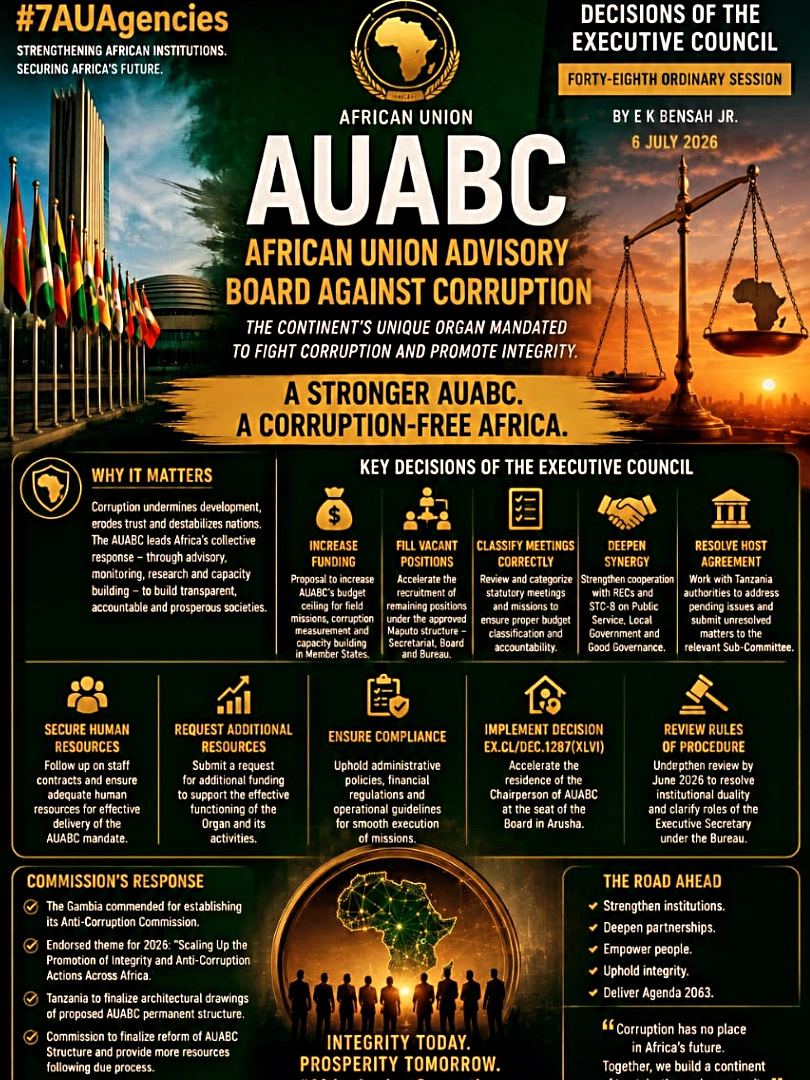
The Decisions acknowledges the limited funding, explaining “Recognizing AUABC’s limited budget”, the Commission “should submit to the relevant PRC Sub-Committees a proposal to increase AUABC’s budget ceiling to enable it to conduct field missions and other corruption measurement initiatives, as well as capacity building programmes in Member States.”
This is very encouraging news for an organ that has spent years with limited resources.
With regards to recruitment, the Decisions maintains the “remaining vacant positions under the approved Maputo structure should be accelerated by the Commission.” The Maputo structure envisions a Secretariat; Board; and Bureau, comprising Chairperson; Vice Chairperson; and Rapporteur. They plan the Board’s activities.
The Commission is instructed to “review the classification of statutory meetings and missions of AUABC and categorize them correctly ensuring that those under programmes are not reflected as operational.”
On deepening institutional synergy, the AUABC is encouraged to “have closer cooperation with RECs and Eighth STC (STC
8) to leverage the expertise and resources for anti-corruption work and policy harmonization.”
According to the AU, the Specialized Technical Committee on Public Service, Local Government, Urban Development, and Decentralization (STC8) remains one of the key organs of the African Union, mandated to ensure effective governance; public service delivery; and sustainable urban development across Member States.
Reports indicate that STC8 has “consistently provided a platform for dialogue and collaboration, fostering the development of policies and strategies that promote decentralization, good governance, and sustainable urbanization in Africa.”
Crucially, the AU-STC No. 8 seeks to be “a vital platform for member states to collaborate on enhancing public service delivery, advancing local governance, and promoting sustainable urban development.”
Still on the effective functioning of AUABC, the Decisions calls on “the Commission and AUABC management to coordinate and follow up closely with the relevant offices in the Government of Tanzania to address pending issues on Host Agreement, and also to submit any unresolved issues on Hosting Agreement to the relevant Sub-Committee for consideration.”
An AUABC without adequate human resources is unable to prosecute the fight against corruption at the continental level. To this end, the Decisions calls on “the Commission with AUABC management to follow up and coordinate closely staff contracts.”
Further, and even more critically, the Commission and the AUABC are “to submit a request for additional funding to the relevant Sub-Committees for the effective functioning of the Organ and any unresolved issues on Hosting Agreement to the relevant Sub-Committee for consideration.”
The Decisions calls on the AUABC “to ensure compliance with administrative policies, financial regulations, and operational guidelines, and to continue consultations to enable smooth execution of missions and activities of the Board.”
With respect to internal administration of the Bureau, the Decisions report calls on the Commission “in collaboration with AUABC to accelerate the implementation of decision Ex.CL/Dec.1287(XLVI) of February 2025 with respect to the residence of the Chairperson of AUABC at the seat of the Board in Arusha.”
Limited funding has meant that there remain complications around the residence of the AUABC Chairperson, which has not enabled the smooth functioning of the work of the Chairperson. The incumbent Chairperson, Hon. Edem Senanu, from Ghana, frequently has to travel from Accra to Arusha for statutory meetings.
The Decisions report “reiterates that the Executive Secretary is responsible for the day-to-day management of administrative and financial matters under the direct authority and responsibility of the Bureau of the AUABC as the primary authorities responsible for the mandate of the Organ to ensure cohesive oversight and institutional accountability until full implementation of decision Ex.CL/Dec.1287(XLVI).”
The AUABC, together with the Commission – in coordination with the relevant PRC Sub-Committee – has been given a deadline of June 2026 to undertake “a review of the Rules of Procedure of the AUABC for their adoption by the Executive Council” in order to address and resolve the institutional duality at the leadership of the Organ, “which weakens and disrupts the effective functioning of the AUABC.”
The Decision is emphatic that “the revision of the AUABC Rules of Procedure shall clarify the roles and responsibilities of the Executive Secretary, who shall perform his/her functions under the leadership of the Bureau of the Board, the political and administrative authority responsible for the Organ.”
With respect to the AU Commission’s response to the AUABC’s activity report, here are some important takeaways:
▶️The Republic of The Gambia has been congratulated for establishing its Anti-Corruption Commission and for appointing its members, who were confirmed by the National Assembly.
▶️The Commission endorses the theme of the African Anti-Corruption Day and the African Anti-Corruption Dialogue of 2026, namely “Scaling Up the Promotion of Integrity and Anti-Corruption Actions Across Africa”
▶️The Commission has requested the authorities of the United Republic of Tanzania to finalize the architectural drawings of the proposed permanent structure and submit them to the Board for review and approval by the Commission
▶️The Executive Council caĺls upon “the Commission to finalize the reform of the AUABC Structure and provide more resources for the Board following due process.”
All in all, the Decision’s rendering of the reporting of the AUABC makes interesting reading as the Executive Council has made important recommendations to support the work of the AUABC and make it more functional.
Key and critical points include enabling more resources for the AUABC; removing the “institutional duality”; and deepening synergy with STC-8, which mandate includes good governance.
Whether these reforms translate into measurable anti-corruption outcomes will depend less on the quality of the Decisions than on the willingness of Member States and the Commission to implement them.
Catch up on the activities of the AUABC Chairperson Hon Edem Senanu by visiting www.edemsenanu.org, and following him on www.twitter.com/HonEdemSenanu
ENDs
