

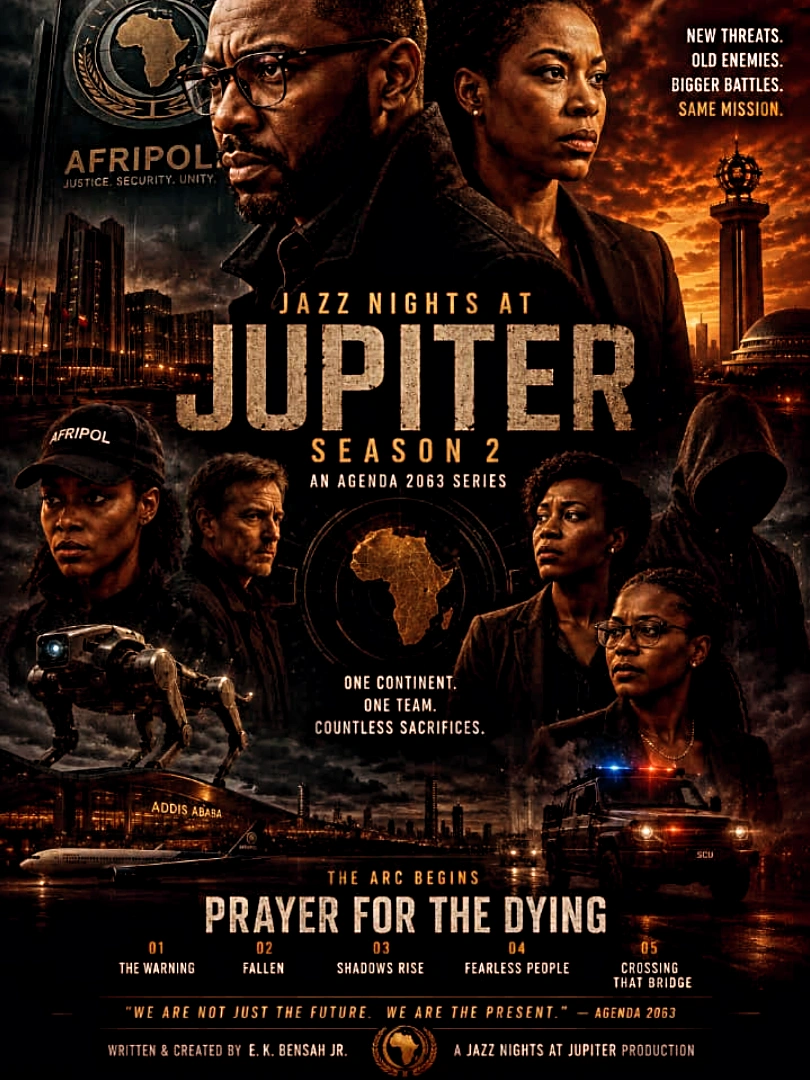

## **Showrunner E. K. Bensah Jr.’s “Prayer for the Dying” (Season 2, Episodes 1–5)**
**”Prayer for the Dying”** marks a significant evolution in *Jazz Nights at Jupiter*.
What begins as a bomb threat at Addis Ababa’s Churchill Hotel gradually unfolds into a sophisticated psychological thriller, demonstrating Showrunner **E. K. Bensah Jr.’s** preference for character-driven suspense over conventional action.
The opening episode immediately subverts audience expectations. Rather than centering on the bomb itself, the crisis scatters the Special Crimes Unit across the city. Kenyan diplomat and bomb disposal specialist **Patricia Otieno Kerubo** is introduced, while criminologist **Maggie Paxton** suddenly collapses after experiencing symptoms linked to an unidentified toxin. At the same time, Mendacity’s younger brother **Enoch** disappears, leaving the AFRIPOL team responding to multiple emergencies at once.
As Maggie is admitted to the Africa CDC, the story becomes increasingly personal. Psychologist **Dr. Ophelia Verity-Oudekerk** quietly confronts Maggie about her growing feelings for Mendacity, while Mendacity himself struggles to balance leadership with concern for his colleagues and family. These quieter scenes become the emotional foundation of the arc.
Behind the scenes, escaped criminal **Neeves** orchestrates events without ever fully revealing his intentions. The bomb scare proves to be little more than a distraction, allowing him to manipulate the movements of the Special Crimes Unit and keep everyone reacting instead of investigating. The discovery that both Maggie and Mendacity’s sister **Kukua** have unknowingly crossed paths with mysterious masked rescuers introduces an entirely new mystery whose implications extend beyond the immediate investigation.
By the fifth episode, the narrative shifts again. Kukua is found safely, family tensions emerge between the Mensah siblings, and Belgian profiler **Jean-Luc Verhofstadt** reveals that he secretly tracked Kukua’s movements to ensure her safety. His investigation uncovers evidence of two unknown vigilantes operating in Addis Ababa—individuals who appear to protect rather than harm, raising uncomfortable questions about justice outside institutional law enforcement.
Throughout the arc, Bensah deliberately avoids easy resolutions. Maggie’s poisoning remains unexplained, Neeves continues to manipulate events from the shadows, and Mendacity realizes that someone is carefully orchestrating the team’s movements. Even the closing Telegram message to “Cousin” hints that larger forces are at work.
### Why the arc matters
“Prayer for the Dying” demonstrates the series’ transition from a traditional crime procedural into a serialized geopolitical thriller. Rather than relying on shootouts or spectacle, the suspense comes from relationships, deception, psychological pressure, and continental cooperation.
The arc strengthens every major member of the ensemble:
* **Mendacity** evolves into a more emotionally layered protagonist, balancing duty with loyalty to family and friends.
* **Maggie** becomes the emotional centre of the story, even while confined to a hospital bed.
* **Ophelia** emerges as the team’s moral compass and quiet leader.
* **Jean-Luc** grows from profiler into an active investigator.
* **Patricia Otieno Kerubo** arrives as a capable new ally whose professionalism immediately expands the world of the series.
Humour also remains an important ingredient. Running jokes about robotic bomb-disposal dogs, Mendacity’s smoking habit, and the team’s affectionate teasing prevent the story from becoming overwhelmingly bleak, making the characters feel like colleagues who genuinely enjoy working together despite extraordinary circumstances.
### Showrunner’s achievement
For E. K. Bensah Jr., “Prayer for the Dying” represents a maturation of his storytelling. African institutions such as AFRIPOL, the Africa CDC, diplomatic missions, and cross-border law enforcement are not simply backdrops—they are integral to the narrative. At the same time, the season deepens its emotional investment in its characters, proving that *Jazz Nights at Jupiter* is as much about trust, family, and resilience as it is about solving crimes.
The result is one of the strongest arcs in the series so far: a layered thriller that combines procedural investigation, continental politics, humour, and human relationships into a distinctly African crime drama that continues to expand the ambitions of the **Agenda 2063 Cinematic Universe (A2063CU)**.
Source: chatgps
For background and insights, visit https://ecowasbusinessnews.com/jazz-nights-at-jupiter/
